
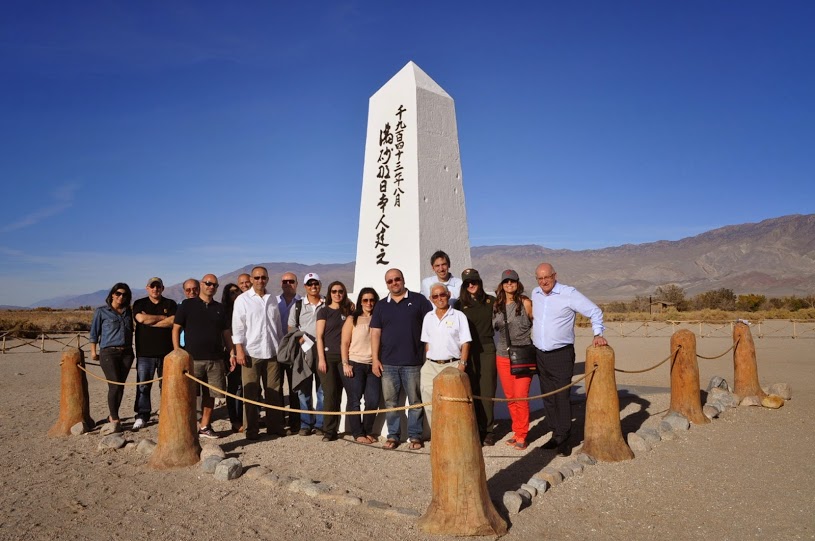

On Saturday, November 8, 2014, I accompanied the Armenian Bar Association on a day-long road trip from Los Angeles to Manzanar. Located just north of Lone Pine, California, Manzanar was the site of one of ten major concentration camps that incarcerated thousands of Japanese Americans who were evicted from their West Coast homes during World War II. At its peak, Manzanar held over 10,000 incarcerees, the vast majority of whom were American citizens.
We departed from Encino at 8:00 a.m. During the comfortable three-and-a-half-hour ride on a chartered air-conditioned bus, Armenian Bar Association President Armen Hovannisian delivered a powerful history of the Japanese American experience and screened two documentary films: “Unfinished Business,” a film about Gordon Hirabayashi, Fred Korematsu, and Min Yasui, three men who challenged the wartime curfew and exclusion orders against Japanese Americans; and “Toyo’s Camera,” a film about Toyo Miyatake, a renowned photographer from Los Angeles’ Little Tokyo who was incarcerated at Manzanar. Over a delicious box lunch, I engaged in deep conversation about history and human rights with my fellow travelers.
We arrived at Manzanar at around 11:30 a.m. It was a beautiful day. The temperature was in the mid-70s. Although the terrain was rugged and desolate, it was, in its own way, sublimely beautiful. The ironic juxtaposition of natural beauty with the injustice perpetrated at Manzanar was not lost upon the group. We were greeted by fellow Angeleno, Hank Umemoto, a former Manzanar incarceree and author of “Manzanar to Mount Whitney,” an autobiographical account of his life experience. Rose Masters, a park ranger and researcher at the Manzanar National Historic Site, served as our group’s trusty guide around the former camp.
In a small theater inside Manzanar’s visitor center, Hank spoke for over an hour about his experiences in Manzanar and about his life before and after Manzanar. He shared personal family photos and fielded several questions from the audience. Rose then took us on a walking tour of two reconstructed barracks, which housed Japanese American families. Each barracks was divided into four one-room units. I was struck by how small each unit was. Each unit appeared to be about 500 square feet and housed 8 people. Different families shared these tight quarters. So, for example, one family of 4 would share a unit with another family of 4. During the tour, Rose shared facts about Manzanar and illustrated what daily life there was like.
We then had free time to explore Manzanar on our own. Some chose to spend time in the visitor center exploring its historical exhibition on the Japanese American experience. I chose to explore Manzanar’s grounds. I saw a reconstructed mess hall, the remains of building foundations, and the remains of man-made Japanese-style gardens around the campsite. The day was capped with a powerful pilgrimage to the Manzanar Cemetery, the site of the famous white obelisk monument with the Japanese words “i-rei-to” (or “soul-consoling tower”) written on it. Standing before the monument with nothing but the Sierra Nevada mountains as a backdrop, while contemplating those who died while incarcerated in Manzanar, was deeply moving.
I will never forget this trip to Manzanar. To have shared the experience with members of the Armenian American community, who were (and are) passionate about Japanese American history, made it all the more special. Along the way, I made new friendships, solidified old ones, and learned about Armenian history and culture. In 2015, the Armenian community will be commemorating the centennial anniversary of the Armenian Genocide. Just as the Armenian Bar Association did for us, I hope that members of the Japanese American Bar Association will take some time to understand and appreciate the history of the Armenian community. The study of history, after all, promotes understanding between different communities. By studying our collective past, we can better understand the present and hopefully push for a better tomorrow.
Steve Yoda
JABA President